rizzitgo Rain Commute Shoe Grip Guide
rizzitgo Rain Commute Shoe Grip Guide
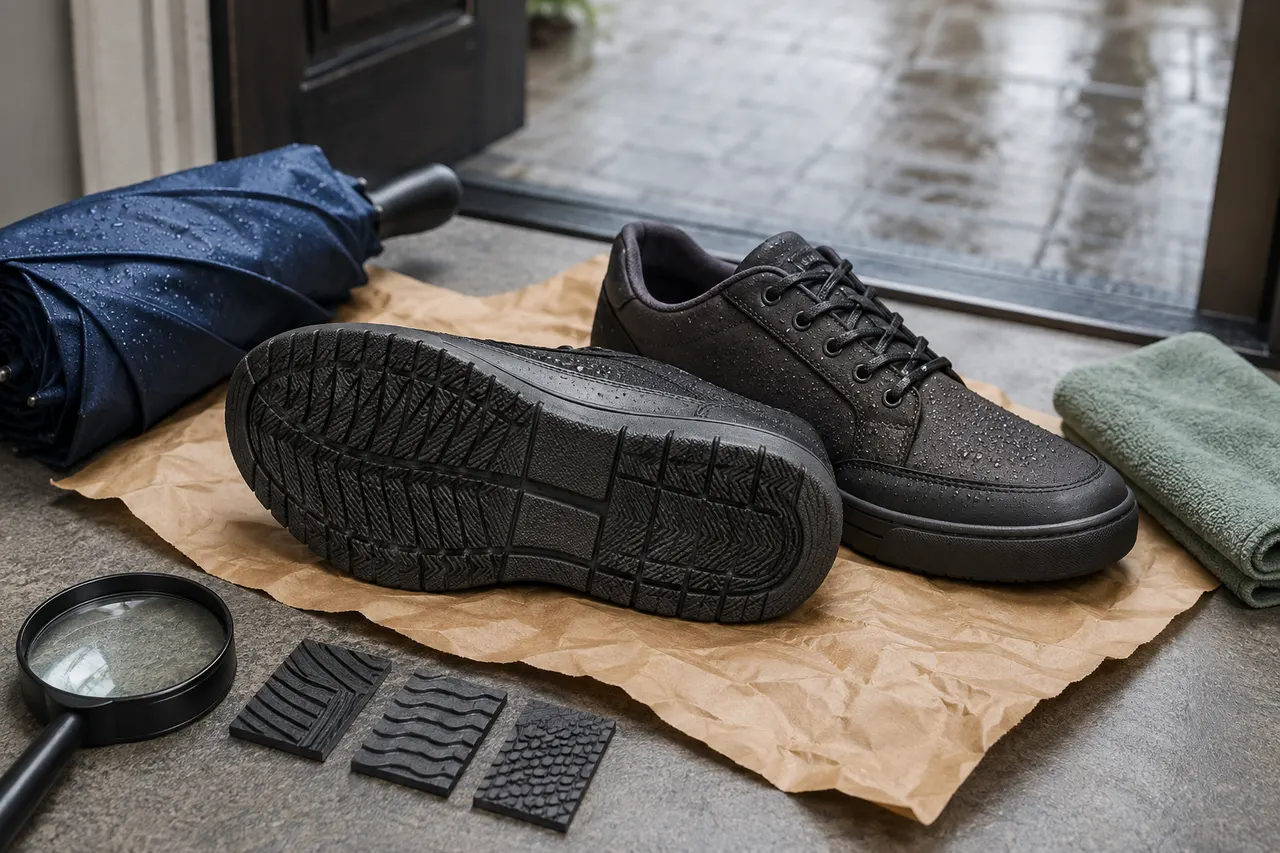
When buying shoes for rainy commutes, it's easy to be misled by words like "non-slip," "wear-resistant," or "thick sole." The real issue isn't whether the shoes look athletic enough, but whether they can keep you stable when starting, stopping, and turning on the wet tiles, subway platforms, crosswalks, stair edges, and office entrance mats you encounter every day.
This is only for pre-purchase screening and warehouse QC review, not a substitute for actual slip testing. If the rizzitgosheets.net page only provides upper shots, side views, or vague selling points without clearly showing the sole, edge wrapping, and high-wear areas, it's best to hold off on that candidate and not rush to pay. 🌧️
First, define the real surfaces of a rainy commute
A rainy commute isn't a single condition. You need to break down your own route first, rather than directly asking "which pair is most slip-resistant." Common risks usually come from several types of surfaces:
Wet polished tiles at residential or mall entrances, where slipping is easy when starting or turning.
Metal edges of subway stations, overpasses, and underpasses, and stair nosings, where heel pressure is concentrated during landing.
Asphalt roads and sidewalk puddles, where the sole's drainage ability matters more than just tread depth.
Office entrance mats transitioning to smooth floors, where the sole can lose stability when drying from wet to semi-dry.
Shared bike pedals, bus steps, and elevator metal plates, which require controllable friction in the forefoot.
If your route is mostly indoor subway and office buildings, focus on fine cross-directional tread, forefoot flex zones, and heel strike areas. If you walk through puddles, sidewalks, and slopes, focus on whether the outsole has drainage grooves, edge gripping blocks, and clearly visible heel tread.
What sole information to prioritize on rizzitgo pages
When viewing shoes on rizzitgosheets.net, it's recommended to first look for information that can be confirmed by images, then read the copy. If the page has multiple angles, prioritize in this order: sole bottom view, heel bottom, toe cap edge wrapping, outer side edge, inner side flex zone, insole or size info.
A candidate suitable for rainy commutes should at least show these points from the page or subsequent QC images:
Check Item | Acceptable Signal | Caution Signal |
|---|---|---|
Outsole tread | Clear grooves in both forefoot and heel, not completely smooth on left and right | Only decorative tread in the middle, landing areas nearly flat |
Toe cap wrapping | Continuous wrapping at toe edge, clear seam position | Rough exposed glue line at toe, unclear edge |
Heel structure | Independent tread or wider ground contact in heel strike area | Narrow, hard heel with shallow tread, small ground contact in rain |
Outer side wear area | Visible thickness or anti-wear treatment on outer edge | Very thin outer edge, side view doesn't show outsole extension |
These judgments come only from page-visible information and QC image review, and should not be written as "guaranteed slip-resistant." If the page lacks sole images, even if the title says non-slip, it only means the claim isn't supported by images. 🔍
Check if the outsole tread suits wet starts and stops
The key for wet commutes isn't complex-looking tread, but whether the tread is in the actual load-bearing areas. The forefoot handles starting, turning, and climbing stairs; the heel handles landing and braking. If only the middle of the sole has patterns while the front and rear landing areas are flat, the actual benefit is limited.
When screening, look at the outsole for three actions:
First, check if the forefoot has transverse or diagonal tread. When starting from subway stations, bus stops, or stairways in rain, the forefoot pushes off first. Transverse grooves generally provide better friction boundaries than large smooth rubber areas.
Second, check if the heel has an independent landing area. Many shoes look thick from the side, but the heel bottom may be quite flat. When braking in rain, the heel contacts the ground first; if tread is lacking there, a thick sole doesn't automatically mean stability.
Third, check if the grooves allow drainage. Very fine, shallow, densely decorative tread may be quickly affected by a water film on wet ground. Commute shoes don't necessarily need deep lugs like outdoor shoes, but at least the water should have a visible path to drain from the forefoot and heel.
If the page only has model on-foot shots, upper views, and side views, it's best to put it in the "pending QC supplementary images" category rather than "ready to order."
Inspect high-wear areas: toe, heel, and outer edge
Rain shoes need more than slip resistance; commute wear is also a factor. Daily walking usually wears out the toe, outer heel, and outer forefoot edge first, not the center of the upper.
For the toe, check if the wrapping is continuous. In rain, kicking steps, curbs, or bike pedals repeatedly stresses the toe. If there's no wrapping, or the junction between wrapping and upper is blurry in photos, request a close-up of the toe in QC.
For the heel, look at the landing area and outer wear zone. Many people land on the outer heel first; if the outsole's outer edge is thin, grip will decline faster after wear in rain. Side views can show some thickness, but bottom views are better to confirm if the outer tread extends to the edge.
For the outer forefoot edge, check flexing and bonding. Frequent stair climbing, rushing, and turning during commutes repeatedly flex the outer forefoot. If the page shows uneven glue lines, broken wrapping, or an overly narrow outsole edge, it's not a top choice for high-frequency rainy commutes. 👟
Distinguish slip-resistant claims, image evidence, and missing information
Page copy can serve as search clues, but cannot replace evidence. Especially for rainy commute shoes, three types of information should be recorded separately:
Promotional info: such as non-slip, wear-resistant, lightweight, suitable for commuting. These only state selling points, not actual performance.
Image evidence: such as outsole grooves, heel landing area, toe wrapping, outer edge thickness. These can support initial screening.
Missing info: such as material hardness, wet tile friction, actual weight, long-term wear, and likelihood of sole separation after rain. These cannot be assumed from images.
A safer way to phrase it: if images show forefoot and heel tread, you can say "has a basis for further review"; if no sole images, only say "insufficient page evidence." Don't write "looks like it has tread" as "definitely slip-resistant in rain," and don't equate thick soles with wear resistance.
For platforms like rizzitgo, which aggregate products through tables or product pages to help users discover items, buyers should treat the page as a candidate pool and use QC images for secondary confirmation. The platform page is for discovery and comparison; warehouse images are for verifying details—the two steps shouldn't be mixed.
Use QC images to record angles that need supplementation
After ordering, during warehouse inspection, the most valuable additional photos for rainy commute shoes aren't the box, but the sole and edges. If QC images only show the front and side, request additional angles, otherwise it's hard to judge before consolidation and shipping.
Recommended photos to record:
Full sole bottom view: confirm continuity of tread across forefoot, arch, and heel.
Close-up of heel bottom: confirm landing area is smooth, not tilted, and free of obvious defects.
Close-up of toe wrapping: confirm glue lines, impressions, openings, and left-right symmetry.
Close-up of outer edge: confirm thickness in high-wear area and whether outsole extends to the edge.
Left and right shoes from the same angle for comparison: confirm tread, wrapping, and shape consistency.
If QC images reveal very shallow tread, obvious heel tilt, toe separation, or inconsistent outsoles between left and right, handle it within the return/exchange window rather than waiting until after international shipping. International returns are usually more costly, take longer, and make it harder to prove the issue existed before shipping. 📦
Risk scenarios not suitable for judgment by page alone
Some rainy scenarios cannot be judged by rizzitgo pages or ordinary QC images alone. For example, if you pass through hospitals, kitchens, laboratories, oily floors, icy surfaces, steep slopes, long-distance cycling, or workplaces requiring occupational safety shoes, ordinary commute shoes should not be treated as professional slip-resistant equipment.
Consider lowering expectations or choosing more specific functional shoes in these cases:
Work environment requires slip resistance ratings, insulation, puncture resistance, or safety certifications.
Commute route often has oil-water mixed surfaces.
Winter icing in your area, where ordinary rubber tread cannot replace ice traction devices.
Long standing hours, and the page lacks midsole support and insole information.
High requirements for sole hardness, arch support, or sizing consistency.
Also note that images cannot confirm rubber compound or wet friction coefficient. Even if the outsole tread looks reasonable, it only means the shoe is more worthy of being a candidate than one with insufficient evidence, not an absolute safety conclusion.
Next step: keep candidate shoes with sufficient evidence
When screening rizzitgo rainy commute shoes, the practical conclusion isn't choosing the "most slip-resistant," but eliminating styles with insufficient evidence and keeping candidates worth QC review.
You can decide in this order: first confirm your own rainy surfaces, then check if the page has sole images; if sole images exist, check forefoot and heel tread, if not, mark as pending evidence; then check toe wrapping, heel landing area, and outer wear area; finally, during warehouse stage, use QC images to confirm left-right consistency, clear tread, and no obvious edge defects.
Styles worth further consideration generally meet these conditions: clear outsole images, visible tread on both forefoot and heel, continuous toe wrapping, outer edge not thin, and QC can provide supplementary key angles. The added cost is mainly more time comparing images and possibly requesting extra QC photos; the benefit is lowering the probability of buying shoes that claim slip resistance but lack evidence.
People who shouldn't use this page-based initial screening method are clear: buyers who need occupational safety certifications, frequently walk on oily or icy surfaces, cannot afford return/exchange time, or must confirm sizing and slip performance the same day. For these scenarios, prioritize shoes with clear standards, after-sales paths, and local try-on options. ✅
agent platform shopping FAQ
1. How do I find a product I want to buy on rizzitgosheets.net?
On rizzitgosheets.net, you can either enter a single keyword in the search bar or navigate to a category page where items are also sorted by brand. If your search term is long, you'll get fewer but more targeted results compared to a shorter term. For instance, try searching "Air Force 1 White," "sneakers," or just "Air Force 1."
Browse our latest products and find your next favorite item.