rizzitgo Linen Shirt Spreadsheet Guide
rizzitgo Linen Shirt Spreadsheet Guide
When buying a linen shirt, the real difficulty is not finding more styles, but judging whether a Spreadsheet entry provides enough evidence for you to compare climate suitability, ease of movement, and fabric composition. This guide is for organizing candidate entries from rizzitgosheets.net into an actionable checklist, ultimately keeping products with complete evidence rather than ordering solely based on the word "linen" in the title or product images.
As of August 27, 2026, this draft has no real-time product samples, prices, inventory, shipping, return/exchange policies, or seller pages that can be verified item by item, so it does not recommend any specific product, nor does it treat names that may appear in the Spreadsheet as proof of material. Prices, inventory, sizes, product links, and policies still need to be double-checked against the product information visible at the time of ordering.
This method is suitable for buyers who have already found linen shirt candidates in the rizzitgo Spreadsheet but don't know how to narrow down the options. It is not suitable for those who need authenticity verification, guaranteed exact delivery dates, or those who still want to place an order without any garment measurements and fabric evidence.
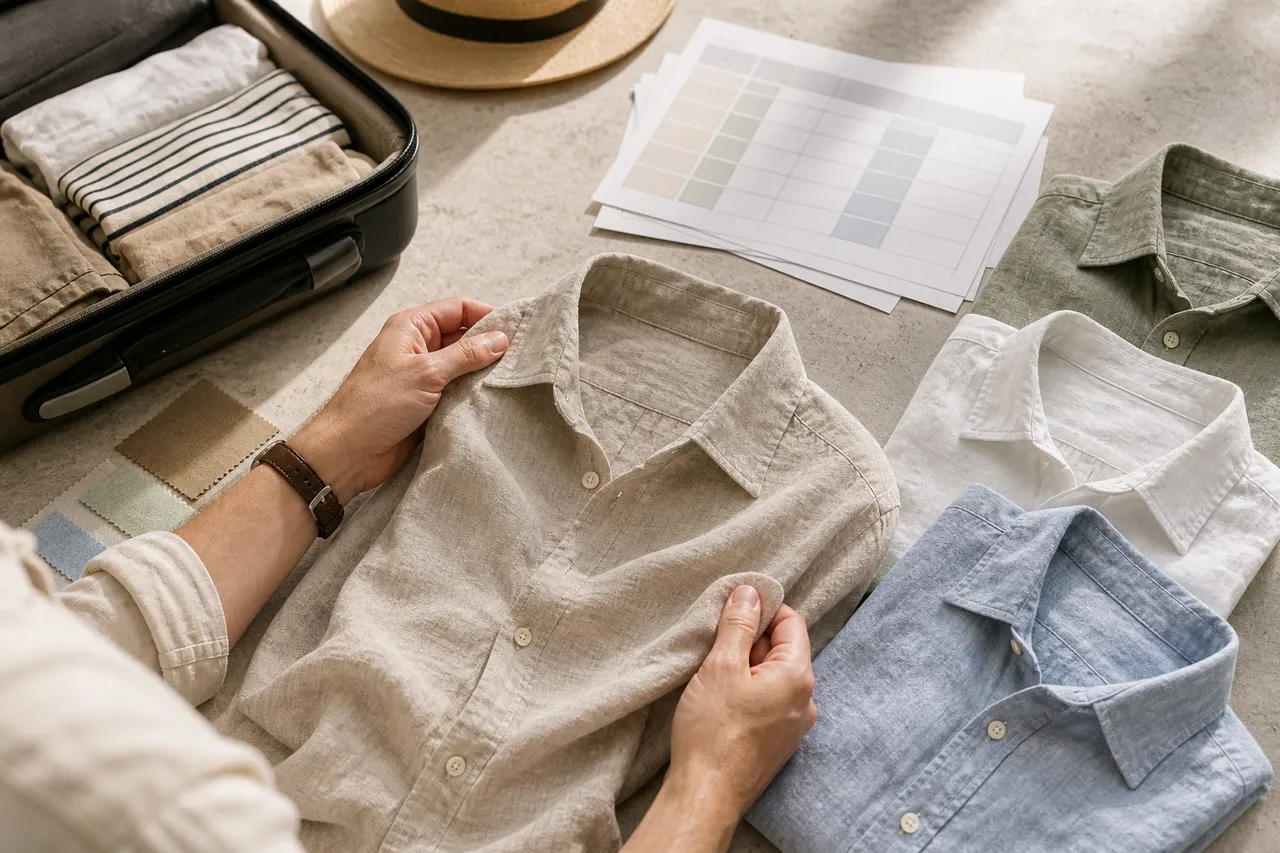
First determine the wearing climate, occasion, and layering needs
Write down the actual usage conditions before opening candidate entries. ☀️ "Wear in summer" is still too broad; you should further specify temperature, humidity, sunlight intensity, indoor air conditioning, and whether layering is needed.
You can start by answering four questions:
Is it mainly for hot and humid, hot and dry, or environments with large temperature differences?
Is it worn alone, open as an outer layer, or over a tank top or short-sleeved shirt?
Is the occasion more for commuting, travel, beach, or daily casual wear?
Can you accept obvious wrinkles, slight transparency, and more frequent ironing or steaming?
Hot and humid environments generally require more relaxed ease and verifiable lightweight fabric information; strong sunlight scenarios may prioritize long sleeves, but you still need to check fabric density and transparency; air-conditioned environments or layering uses cannot just pursue the thinnest option. The goal here is not to judge which design is universally best, but to establish screening criteria consistent with your usage conditions.
What information the rizzitgo Spreadsheet can provide
Treat the rizzitgo Spreadsheet as a candidate index, not the final proof of product facts. Whether the table can support judgment depends on the fields actually displayed and accessible evidence for each entry at the time.
Prioritize checking whether the following exist:
Recognizable product name, style, or item number
Valid product information link
Garment measurements with units
Fabric composition and percentages
Collar type, sleeve type, length, or fit description
Front, back, detail, care label, or size chart images
Price, inventory, sizes, and return/exchange conditions visible at the time
If an entry only has a title, thumbnail, or vague "linen-like" description, mark it as pending verification rather than automatically classifying it as a linen shirt. If the link redirects to an irrelevant page, the page lacks a clear product name, or key information is inaccessible, that entry should not enter the final candidates.
Build a candidate range using collar type, sleeve type, and length
Filter the silhouette first, then compare details, to avoid wasting time on styles that obviously don't fit the scenario. 👔
Filter | Better suited needs | Additional checks |
|---|---|---|
Lapel collar or Cuban collar | Casual wear alone, open layering | Collar opening width, whether collar tips easily curl |
Stand collar or short collar | Clean look, light commuting | Collar circumference, position of top button |
Long sleeves | Sun protection, air conditioning, or cross-season use | Sleeve length, cuff width, thickness after rolling up sleeves |
Short sleeves | Direct wear in hot weather | Upper arm circumference, whether cuffs are too tight |
Regular length | Tucking into trousers or commuting outfits | Whether front and back lengths are consistent |
Shorter length | Untucked, emphasizing proportions | Whether it easily exposes the waist when raising arms |
Do not judge length and looseness solely based on model photos. Shooting angles, model body shape, and whether the hem is tucked into trousers will change visual proportions. When flat measurements are missing, you can keep the style as a backup, but it should not be listed as a candidate for immediate order.
Determine ease of movement using garment measurements
Size names cannot replace centimeter or inch data. 📏 The same size M may have different chest, shoulder width, and length in different products, so you should first measure a shirt that fits you well and has a similar fit, then compare it with the product's garment measurements.
Recommended flat measurements:
Width from underarm to underarm, and confirm whether the product table lists half chest or full chest circumference
Shoulder width between shoulder seams
Sleeve length from shoulder point to cuff
Back length from back collar point to hem
Upper arm or cuff width, especially if you have thicker arms or plan to roll up sleeves
Ease of movement should be calculated by "product garment measurement minus body measurement" or by direct comparison with an existing well-fitting shirt. Do not directly subtract body chest circumference from flat half chest measurement, and do not guess when units are unclear. If the size chart, product description, and option names conflict, confirm with the seller first and save the response; do not rely on any of these numbers before confirmation.
Shrinkage rate also cannot be estimated from the general fact that "linen usually shrinks." Only when the product page, care label, or seller provides clear instructions applicable to the specific fabric can shrinkage information be included in sizing decisions.
Check linen content, blends, and fabric evidence
The title containing linen, linen-like, or cotton-linen does not prove the specific fiber content. 🔍 Evidence strength can be judged in the following order:
Clear care label showing both fiber names and percentages.
Product specification field provides complete composition ratio and matches the care label.
Seller provides a savable composition response for the specific product.
Product title or marketing description only uses words like "linen-like" or "cotton-linen feel."
Guessing material only from texture photos or model appearance.
Only the first three types of evidence are suitable for supporting composition judgments; the last two can only serve as pending verification clues. Blends themselves do not mean lower quality, but you must know what is blended and in what proportion to evaluate feel, wrinkling, care, and durability. Without percentages, do not interpret "cotton-linen" as half cotton and half linen.
Check transparency, stitching, buttons, and care label images
The purpose of image inspection is to identify issues that need confirmation, not to write visual observations as conclusions from touch or testing.
When viewing light-colored shirts, look for backlit images, single-layer hem images, and comparisons between pocket and non-pocket areas. Display images cannot prove that the shirt is not transparent under all lighting and skin tones, so when relevant evidence is lacking, mark transparency as unknown.
Detail images should also cover:
Whether stitching on collar tips, placket, and hem is continuous
Whether there is obvious loose thread around buttonholes
Whether spare buttons are visible, but do not assume they are included if image is unclear
Whether patterns, stripes, or pocket positions are aligned
Whether care label composition, care symbols, and origin information are clear
Whether size label matches current options
If buttons, pockets, colors, or care labels are clearly inconsistent across different images, it may be different batches, different styles, or incorrect images. In that case, pause selection and confirm the specific version you will receive.
Evaluate care difficulty, packaging wrinkles, and return/exchange boundaries
Care methods for linen and its blends cannot be generalized; follow the specific care label and seller instructions. 🧺 Before ordering, at least confirm whether machine washing is allowed, allowed water temperature, whether tumble drying is possible, and whether low-temperature ironing is needed. If the care label is not visible, treat care costs as unknown conditions.
Folding and compression during international shipping may cause packaging wrinkles, but images cannot prove in advance that these wrinkles can be completely removed. After receiving warehouse inspection photos, check for stains, holes, obvious size errors, missing buttons, and severe stitching issues; fabric feel, real breathability, and wearing comfort usually cannot be confirmed from warehouse photos alone.
Also record return/exchange boundaries:
From what point does the return/exchange request period start
What issues can be handled during warehouse inspection
Whether color differences, minor loose threads, or size deviations are excluded
Who bears domestic shipping and service fees for returns
Whether returns/exchanges are still possible after the item leaves the warehouse
These are time-sensitive policies. Follow the rules still visible on the page when ordering after August 27, 2026, and save screenshots of the product page, size chart, care label image, seller response, and return/exchange conditions.
Organize the pre-order checklist
Organize each candidate into a row, leaving unknown content blank or marking "pending confirmation," do not fill in with common sense.
Check item | Condition for entering final candidates |
|---|---|
Usage scenario | Climate, occasion, and layering method have been determined |
Fit | Collar type, sleeve type, and length meet usage needs |
Size | Garment data with clear units, and compared with existing shirt |
Fabric | Evidence of fiber name and proportion, or explicitly accepted risk of unknown composition |
Images | Able to check main appearance, workmanship, care label, and size label |
Product status | Re-verify price, inventory, options, and valid link on the day of order |
Return/exchange | Confirmed window, exclusions, and possible costs |
Evidence retention | Saved key pages, images, and seller responses |
If two candidates look similar in appearance, prioritize keeping the one with more complete size, composition, and return/exchange evidence, rather than defaulting to the lower-priced one. Lower price cannot offset the risks of wrong size, material mismatch, or inability to return.
Next step: Keep candidates with complete evidence
After filtering, divide candidates into three groups: "orderable," "awaiting confirmation," and "excluded." ✅ The orderable group should have key evidence such as size, fabric, images, and return/exchange boundaries; the awaiting confirmation group only keeps issues that can be resolved through seller responses or new images; entries with broken links, unclear products, conflicting data that cannot be confirmed should be directly excluded.
This method cannot calculate a definite savings amount without specific prices, shipping, and return costs, so do not promise how much you can save. It may reduce the probability of choosing the wrong size, misidentifying fabric, and post-purchase disputes, but it will increase verification time and may reduce the number of options. It is suitable for buyers who value climate suitability, fit, and evidence completeness; it is not recommended for those who must order immediately, cannot obtain garment measurements, or cannot accept limitations of international purchase returns.
Agent Platform Shopping FAQ
1. What kinds of items can be found at rizzitgosheets.net?
rizzitgosheets.net carries a broad assortment of product lines, covering footwear, tees, knitwear, hooded sweatshirts, denim, joggers, shorts, swim trunks, clearance from factory stock, padded coats, baseball-style tops, button-up shirts, headwear, accessories, bags, gadgets, shades, hosiery, undergarments, and popular limited-edition figures.
Browse our latest products and find your next favorite item.